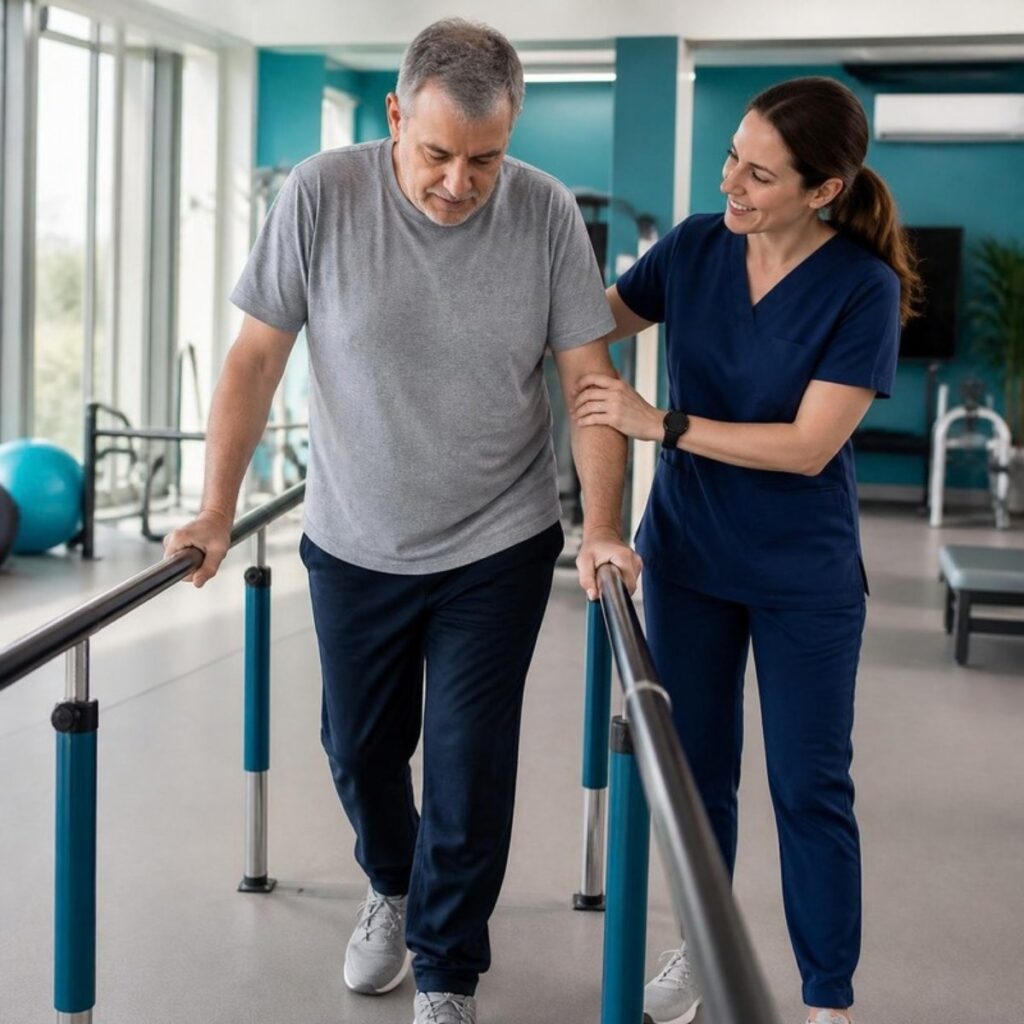
Many people know their symptoms before they know a diagnosis. If any of these sound familiar, physiotherapy may help, with or without a confirmed diagnosis.
Every plan is built around the activities that matter to you, in our Spruce Grove clinic or in your home.
Gait retraining
Practice and feedback to walk more safely, efficiently and further.
Balance and coordination exercises
Progressive challenges to improve steadiness and control.
Neuromuscular re-education
Retraining how muscles switch on and work together.
Functional mobility training
Getting in and out of bed, chairs, cars and up and down stairs.
Strengthening
Targeted exercise for weak muscles and overall fitness.
Task-specific rehabilitation
Practising the real activities you want to get back to.
Fall prevention
Assessment of fall risk, strategies and a safer home.
Caregiver training
Teaching family members how to help safely at home.
Browse by category. Highlighted conditions link to a page with more detail.
01
Stroke & cerebrovascular conditions
After a stroke, the brain can relearn movement through practice. Rehab focuses on the activities that matter most to you.
Practice of walking, standing, transfers and arm use, with strengthening and balance work to rebuild independence.
Transient ischemic attack (TIA)
Guidance on safe activity, balance and fitness after a TIA, alongside the medical care your doctor provides.
Recovery after a brain aneurysm or bleed
Once medically stable, gradual rehab for strength, balance, endurance and returning to daily routines.
02
Parkinson’s disease & movement disorders
Regular, targeted exercise can help people with movement disorders stay active and manage symptoms in daily life.
Larger, purposeful movement practice, strategies for freezing of gait, balance and fall prevention, and a home exercise routine.
Atypical parkinsonism (e.g. PSP, MSA)
Safety-focused balance, transfer and walking practice, with equipment advice and caregiver training.
Essential tremor
Strategies and positioning to reduce the impact of tremor on everyday tasks, plus general strength and fitness.
Dystonia
Posture, stretching and movement retraining to ease discomfort and improve control, alongside medical treatment.
Huntington’s disease
Balance, walking and fall-prevention work to support safety and mobility for as long as possible.
03
Multiple sclerosis & demyelinating disorders
Rehab is tailored to your symptoms on the day, with careful pacing to manage fatigue and heat sensitivity.
Strength, balance and walking practice, fatigue management and support during and after a relapse.
Transverse myelitis
Graded rehab for leg weakness, walking, balance and transfers as recovery allows.
Neuromyelitis optica spectrum disorder (NMOSD)
Exercise, mobility and balance work adapted to vision, strength and sensation changes.
04
Brain injuries & concussion
From mild concussion to more serious brain injury, rehab rebuilds physical skills step by step.
Balance, coordination, walking and endurance training, with goals set together with you and your family.
Acquired brain injury (e.g. after surgery, tumour or lack of oxygen)
Task-focused practice to regain movement and confidence in daily activities.
Neck, balance, vision and exercise-tolerance work, with a staged return to work, school and sport.
05
Spinal cord injuries & neurological spinal conditions
Rehab focuses on what is possible now and on building strength, skills and independence over time.
Walking, balance and strength training to make the most of recovering movement.
Transfers, upper-body strength, positioning and fitness to support everyday independence.
Cervical myelopathy
Balance, hand-function and walking practice, before or after surgery, as advised by your surgeon.
Spinal stenosis with leg symptoms
Exercise and walking strategies to improve tolerance for standing and walking.
Cauda equina syndrome (recovery after surgery)
Rehab for leg strength, walking and pelvic floor function after urgent medical treatment.
06
Peripheral neuropathy & nerve injuries
When nerves outside the brain and spine are affected, rehab targets balance, strength and safe walking.
Diabetic peripheral neuropathy
Balance training, foot-care awareness and walking strategies to lower the risk of falls.
Chemotherapy-induced neuropathy
Balance, strength and sensory strategies during and after cancer treatment.
Guillain-Barré syndrome (recovery)
Carefully graded strengthening and endurance work as nerves recover, avoiding overload.
Peripheral nerve injuries (including foot drop)
Strengthening, walking retraining and advice on braces such as ankle-foot orthoses.
Brachial plexus injuries
Shoulder and arm movement, strengthening and function-based practice as recovery allows.
Movement-based assessment and exercise to ease leg symptoms, including the McKenzie approach.
07
Motor neuron & neuromuscular disorders
For progressive conditions, the focus is staying active, safe and comfortable, and planning ahead for changing needs.
Amyotrophic lateral sclerosis (ALS)
Energy-conserving exercise, positioning, equipment advice and caregiver training.
Muscular dystrophies
Appropriate exercise, stretching and mobility support suited to the type and stage of the condition.
Myasthenia gravis
Paced strengthening and fatigue management that respects symptom fluctuation.
Post-polio syndrome
Pacing, joint protection and gentle strengthening to manage fatigue and weakness.
Charcot-Marie-Tooth disease
Balance, ankle and foot strength, and advice on footwear and braces.
08
Cerebellar & coordination disorders
Coordination and balance can improve with focused, repeated practice.
Cerebellar ataxia
Coordination, balance and walking practice with strategies to stay steady during daily tasks.
Hereditary ataxias (e.g. spinocerebellar ataxia)
Regular balance and gait training to support mobility and confidence.
Targeted balance, coordination and walking rehab after stroke.
09
Vestibular & balance disorders
Inner-ear and balance problems can often be improved with specific exercises and repositioning techniques.
Assessment and repositioning manoeuvres for short spins of vertigo with head movement.
Gaze-stability and balance exercises to help the brain adapt after an inner-ear infection.
Gradual exposure to movement and busy environments, with balance retraining.
Assessment of why you are unsteady, followed by targeted balance and walking practice.
10
Functional neurological disorder
FND is a real and common condition. Physiotherapy is one of the main treatments for its movement symptoms.
Education and specialized movement retraining for functional weakness, walking difficulty and tremor.
11
Pediatric neurological conditions
For children, rehab is play-based, goal-focused and planned together with families and other care providers.
Cerebral palsy
Strength, mobility and functional practice to support walking, play and participation.
Developmental coordination disorder
Motor-skill practice for balance, coordination and confidence in sport and play.
Motor developmental delay
Activities that support milestones such as sitting, standing and walking.
Neurological physiotherapy in Spruce Grove and nearby communities
Sunrise Physical Therapy helps people from Spruce Grove, Stony Plain, Parkland County, Acheson and west Edmonton recover movement and independence after a neurological diagnosis. Care is offered in our Spruce Grove clinic, and in-home visits are available for people who find it hard to travel.